
Home › Reviews › Healthy Paws vs Trupanion
Updated August 2026By Yassine Dekkak, Founder, ComparePetCover · Reviewed August 14, 2026
Healthy Paws and Trupanion are both premium, single-plan insurers with unlimited payouts and no exam-fee coverage — but they split on the details that matter. Trupanion wins for chronic conditions, older pets, and not fronting big bills (per-condition deductible + direct vet pay). Healthy Paws wins on price for a younger pet and sheer simplicity.
Healthy Paws vs Trupanion at a glance
| Healthy Paws | Trupanion | |
|---|---|---|
| Plan | One plan, unlimited annual payouts | One plan, no payout limits at all |
| Reimbursement | Tiered (often 80%) | Fixed 90% |
| Deductible | Annual (resets yearly) | Per-condition (paid once per condition) |
| Payout limit | Unlimited annual | Unlimited (no per-incident/annual/lifetime cap) |
| Direct vet pay at participating clinics | No (pay-first) | Yes — Trupanion Express at participating hospitals |
| Dental illness | Not covered | Covered (as illness, if not pre-existing) |
| Exam fees / wellness | Not covered | Not covered |
| Accident waiting period | 15 days | 5 days |
| Illness waiting period | 15 days | 30 days |
| Older-pet rules | Limited options if enrolled after age 6; no hip dysplasia | No upper-age enrollment restriction |
| Typical dog price | $25 – $90/mo (avg ~$55–$65) | $55 – $110/mo (higher) |
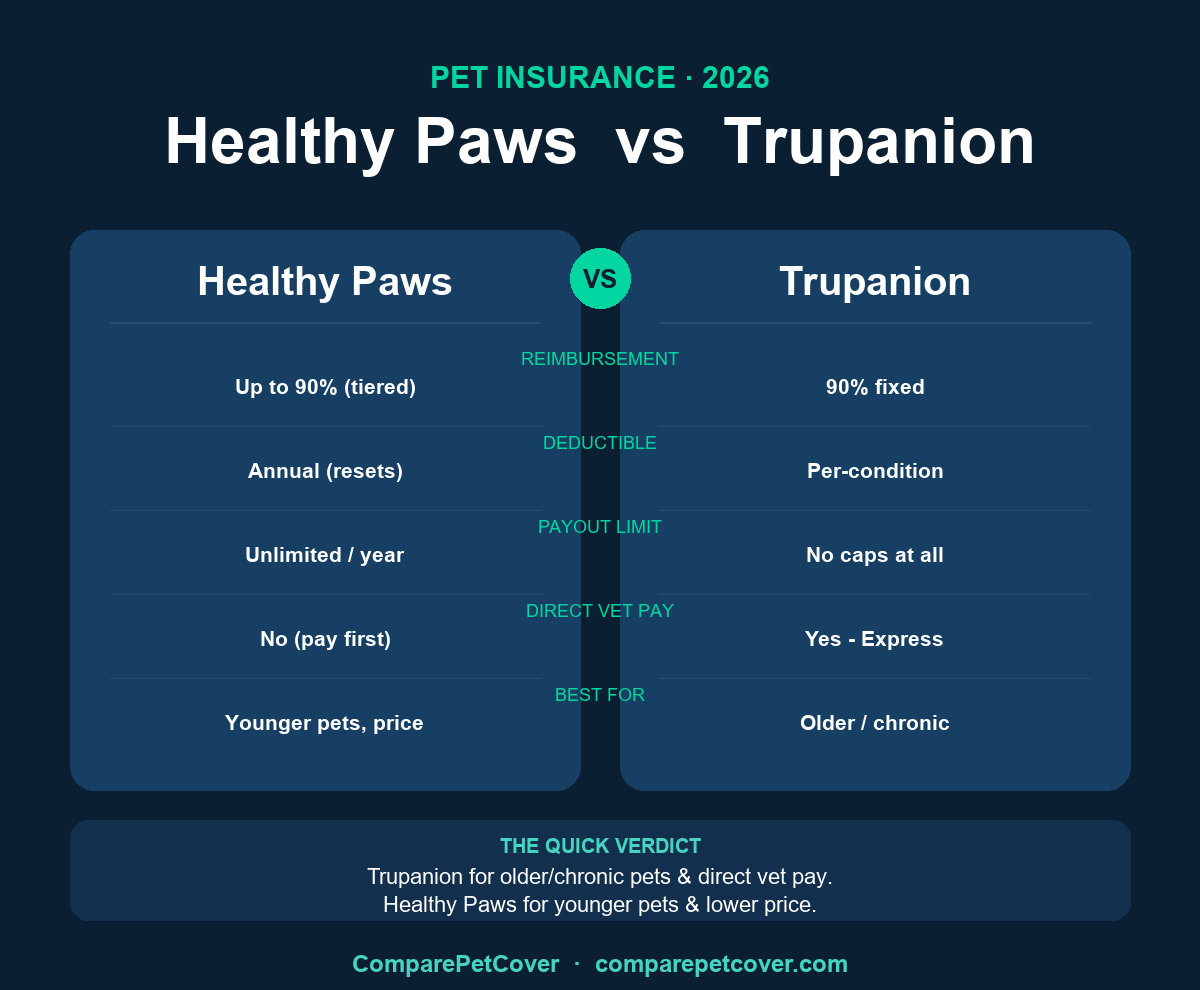
Cost: Healthy Paws is usually cheaper
For a young, healthy pet, Healthy Paws is typically the lower-priced option — sample 2026 dog premiums run about $25–$90/month (avg ~$55–$65) versus Trupanion’s $55–$110. Trupanion costs more by design: a fixed 90% reimbursement (no cheaper tier), unlimited payouts, and the per-condition deductible. The gap narrows for pets likely to develop a chronic condition, where Trupanion’s deductible structure pays off (see below). Use our cost calculator to estimate your own number.
Deductibles: annual vs per-condition (the big difference)
This is the structural split that matters most. Healthy Paws uses an annual deductible that resets every policy year. Trupanion uses a per-condition deductible — you pay it once per condition for the life of that condition, then it’s done. For a pet with a recurring or lifelong issue (allergies, arthritis, a chronic GI problem), Trupanion’s per-condition model can save real money year after year. For a pet that mostly files one-off claims, the annual deductible is simpler and often cheaper.
Reimbursement & payout limits
Both are strong here. Healthy Paws offers unlimited annual payouts on every policy with a tiered reimbursement rate (commonly 80%). Trupanion pays a fixed 90% and goes one step further on limits — no per-incident, annual or lifetime cap at all. For a major, drawn-out illness, both remove the ceiling that trips up capped plans; Trupanion’s slightly higher fixed rate and total absence of caps give it a marginal edge for worst-case scenarios.
Direct vet pay: Trupanion’s standout feature
At hospitals using Trupanion Express, Trupanion can pay your share directly to the vet at checkout — so you don’t have to front a large bill and wait for reimbursement. Healthy Paws is a standard pay-first model: you pay, submit through the app, and get reimbursed (they’re well-reviewed for paying quickly). If fronting a $5,000 emergency bill would strain your budget, Trupanion’s direct pay is a genuine advantage.
Coverage gaps to know
Neither covers vet exam fees or offers a wellness/preventive plan — a shared limitation versus more inclusive insurers like Embrace or Spot. The difference: Healthy Paws also excludes dental illness, while Trupanion covers dental illness as an illness (when not pre-existing). If dental matters to you, that’s a point for Trupanion. If you want exam fees included, look beyond both — see our full provider comparison.
Age & waiting periods
Trupanion is friendlier to older pets: it has no upper-age enrollment restriction, whereas Healthy Paws limits deductible and reimbursement options for pets enrolled after age 6 and makes them ineligible for hip-dysplasia coverage. On waiting periods, Healthy Paws is 15 days for both accidents and illness (12 months for hip dysplasia); Trupanion is 5 days for accidents but 30 days for illness. Either way, enroll while your pet is young and healthy — pre-existing conditions are excluded by both, as with every insurer.
Which should you choose?
- Pick Trupanion if: your pet is older, prone to a chronic/recurring condition, you want the vet paid directly at checkout, you want dental illness covered, or you want a fixed 90% with zero caps.
- Pick Healthy Paws if: you’re insuring a younger pet (under 6), you want the lower premium and one simple unlimited plan, and you’re comfortable with pay-first reimbursement.
Read the full breakdowns in our Healthy Paws review and Trupanion review, or see all top providers compared.
Frequently Asked Questions
Is Healthy Paws or Trupanion cheaper?
Healthy Paws is usually cheaper, especially for younger pets — dogs run about $25–$90/mo versus Trupanion’s $55–$110. Trupanion costs more because of its fixed 90% reimbursement, unlimited payouts and per-condition deductible.
What’s the difference between their deductibles?
Healthy Paws uses an annual deductible that resets each year; Trupanion uses a per-condition deductible you pay once per condition for the pet’s life — cheaper over time for chronic conditions.
Does either pay the vet directly?
Trupanion can, via Trupanion Express at participating hospitals, so you don’t front the full bill. Healthy Paws is pay-first reimbursement only.
Which is better for older pets?
Trupanion — it has no upper-age enrollment restriction. Healthy Paws limits options for pets enrolled after age 6 and excludes hip dysplasia for them.
Do they cover dental illness?
Healthy Paws does not; Trupanion covers dental illness as an illness when it isn’t pre-existing. Neither covers vet exam fees or wellness.
Related: Healthy Paws review · Trupanion review · Lemonade vs Spot · What vets recommend
Compare plans: Top providers · By state · Does it cover surgery?
Head-to-head: Lemonade vs Healthy Paws (2026)